As I described in Down the Rabbit Hole: How The Aroma Book Began, my interest in perfumery began through reading about the importance of scent in Islam. One material in particular caught my attention: musk, described by the Prophet (PBUH) as the best of perfume. I wanted to understand what that scent was.1
That sounded like a simpler undertaking than it turned out to be. The word musk appears on countless bottles, but the white musks, black musks and musk oils I encountered did not necessarily have much to do with the musk I was looking for.
What followed involved years of searching, questions, purchases, disappointments and occasional discoveries. It is not a journey I would recommend repeating. It can be expensive in both money and time, authenticity is difficult to establish, and finding something genuine does not settle the questions of legality or ethics. I am sharing the experience partly so that others do not have to repeat it.
Eventually, the search raised a question I had not anticipated: what happens when the pursuit of a treasured scent begins to conflict with the reasons you wanted it in the first place?
What are we calling musk?
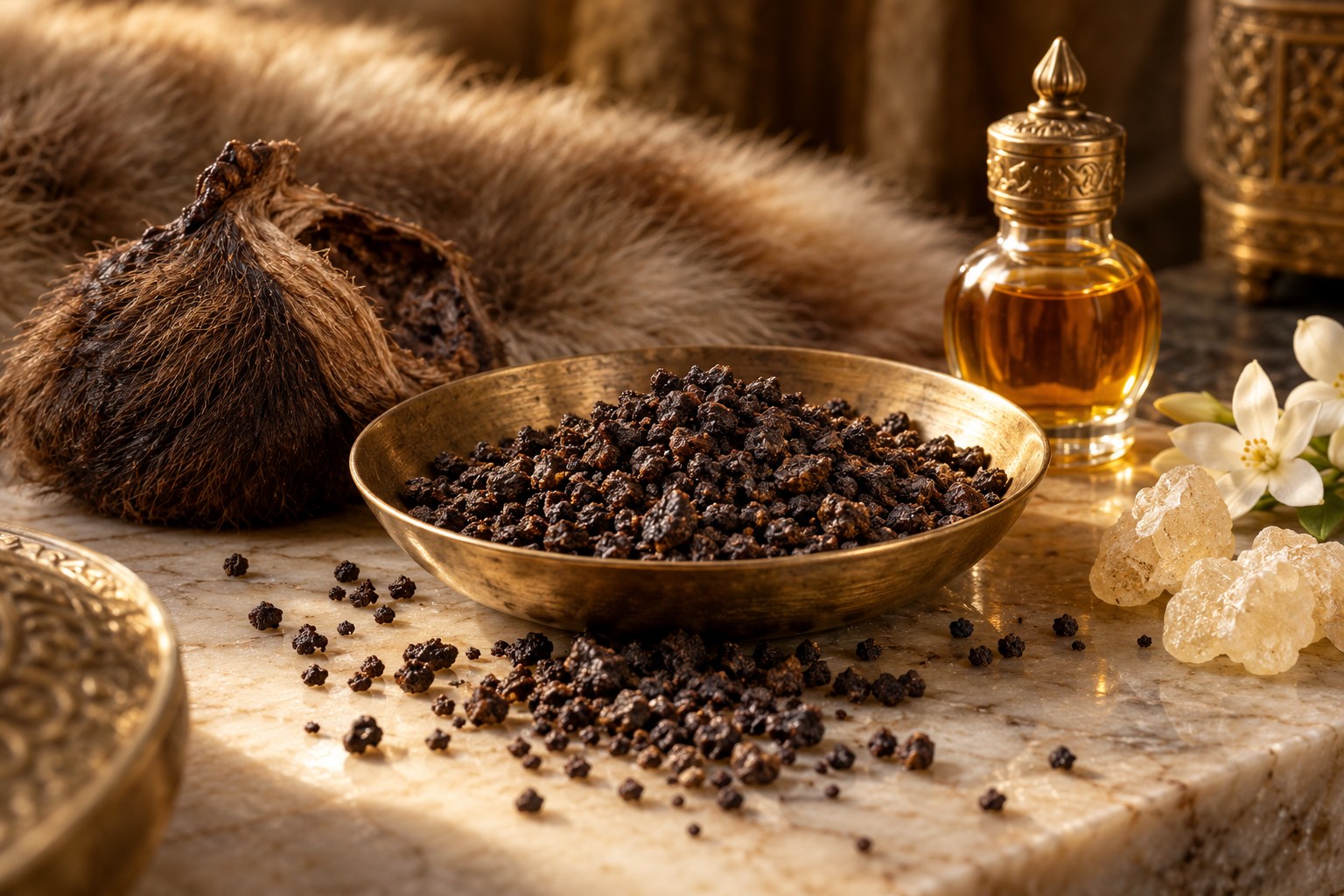
The musk I was searching for was deer musk: a secretion produced by a specialised gland in the adult male musk deer and collected in a pouch commonly called the musk pod, situated on the underside of the abdomen near the genitals. Its scent plays a role in communication, including marking territory and attracting females. Alongside urine and other glandular secretions, it forms part of the animal’s scent communication. Before becoming a perfume ingredient, it serves a purpose in the animal’s own life.2
In my early encounters, however, “musk” seemed to describe almost anything. There was white musk, black musk, red musk and “gazelle musk”. Some smelled clean and powdery; others were dark, sweet or aggressively animalic. I tried to make sense of them as though they were variations of the same raw material.
The name “gazelle musk” also has a linguistic and historical context. In Arabic, ghazāl means gazelle, and older descriptions sometimes presented the musk deer as a gazelle or an animal resembling one. The terminology is understandable, but the zoological distinction matters: deer musk comes from musk deer, not gazelles.3
I also encountered people using “musk” almost as a general term for perfume oil, even when the fragrance had no particular connection to either deer musk or synthetic musks. Sometimes we were using the same word while talking about entirely different things.
Fake and synthetic musks are legion, although the distinction matters: a synthetic musk honestly described is not a fake. The problem begins when something is presented as genuine deer musk without justification. A bottle labelled “musk” was not evidence that it contained deer musk, and a powerful animalic smell was no proof of authenticity either.
There was also a basic question of supply and demand: if genuine musk was so rare and precious, how could it seem so readily available? The apparent abundance, sometimes at remarkably low prices, was difficult to reconcile with the scarcity being described. It gave me another reason to question what was actually behind the name.
I gradually learned to distinguish the pod from its contents: the musk itself, which takes on a granular form as it matures and dries and is commonly referred to as musk “grains”. These grains can then be used in preparations such as oil macerations or alcohol tinctures.
This distinction mattered more than I initially understood. I had been looking for a single, recognisable smell. Instead, I was encountering a word applied to many different perfumes, alongside preparations in which the material itself could be difficult for an inexperienced nose to identify.
Learning what I was smelling
Around 2013, I began sampling some of the dark oils sold as “gazelle musk”. By then, the search had acquired its own momentum.
There was the anticipation of a parcel arriving, the satisfaction of winning an auction, and the excitement of what appeared to be a remarkable bargain. A bottle supposedly worth far more than I had paid for it could feel like a discovery before I had even opened it. Only later did I begin to question what those prices actually represented.
More compelling than the bargain was the possibility of smelling something new. Perhaps this bottle would finally explain what I had been reading about.
The search took me through online shops, eBay, forums and blogs, into Middle Eastern and Asian perfume retailers, and even Chinese medicine shops. Looking back at some of my correspondence, I can see how enthusiasm occasionally became interrogation. I wanted answers, sometimes before I had taken the time to introduce myself properly or understand why someone might be reluctant to give them.
Perfumers are often artists and artisans deeply invested in their work. My enthusiasm sometimes made my questioning more insistent than considerate.
Eventually, I found multiple sources for what I believed was genuine musk. But I did not immediately acquire it. I still had questions about how it had been obtained and whether acquiring it would be lawful and ethically acceptable. I wanted those questions answered first. Only once I was satisfied on those points did I go ahead.
The search had reached a point where I felt comfortable taking that step. The anticipation was considerable: after all the reading, questions and misleading names, I would at last be able to put a smell to the material that had started it all.
The first time I smelled musk, it was in the form of a maceration in sandalwood oil. My first reaction was disappointment. I could mostly smell sandalwood.
I had spent so long reading about musk and looking for it that I expected recognition to be immediate. Surely the best of perfume would announce itself. Instead, I was trying to find a scent I did not yet know beneath another that I could readily recognise.
It took repeated smelling to begin separating the two. I had to train my nose, comparing the maceration with sandalwood on its own and gradually learning what the musk contributed. I also had to recalibrate my expectations: the clean, powdery or forceful oils I had previously known as “musk” had prepared me for something quite different.
Even once I could recognise it, appreciation was not instantaneous. Its rawness and animalic facets were not what I had imagined. Learning to identify musk and learning to enjoy it were related, but separate, parts of the experience.
Gradually, I began to distinguish a warmth and sweetness beneath the sandalwood, something furry and unmistakably animalic. In the samples I came to know, musk could be raw and pungent, with an occasional urinous edge. Yet that description on its own gives the wrong impression. What interested me was how those facets sat within something comforting and strangely attractive.
Beautiful, perhaps, without being pretty.
It did not have the same kind of complexity I found in oud, but it drew me back in a similar way. I kept smelling it, trying to understand what I was recognising and why I wanted to return to it.
The questions behind acquiring musk
Some accounts suggested that musk pods fell naturally, or that grains could be gathered from the ground or from surfaces against which the animal had rubbed. The possibility of obtaining musk without harming the animal was appealing, and the method of collection became a particular focus of my enquiries. At that stage, however, I did not know enough to distinguish a plausible explanation from a reassuring story.
Accounts of farming and extraction from living animals raised different questions. Under what conditions were the animals kept, and what did extraction involve? Being told that an animal had not been killed did not, by itself, settle the ethical question for me. I also wanted clarity about the legality of obtaining the material. (Musk deer are covered by CITES, the international wildlife trade convention, with different levels of protection depending on the population of origin. National laws may impose further restrictions.)4
Clarity on these questions was a condition of acquiring musk. My interest had begun with the place of perfume in Islam, so the means of obtaining it mattered alongside the scent itself.
I also learned to be careful about attributing uncertainty to dishonesty. Even knowledgeable, sincere artisans could be relying on information from their suppliers that they had not been able to verify themselves. Someone could be trustworthy and still be mistaken about what they had been sold.
What was I really looking for?
One question remained difficult to resolve: how did the musk I was experiencing relate to the perfume described in the texts that had inspired me?
I repeatedly encountered the view that musk was best understood as a fixative, or as a subtle contribution to a blend. That did not fully explain the impression I had formed from my reading. Why might the best of perfume fail to smell as wonderful as I expected?
I kept returning to two possibilities.
The first concerned the material itself. Was the musk available to me comparable in quality and character to the musk celebrated in earlier accounts? Origin, handling, storage and preparation might all matter. I wondered whether some of the disappointment lay in the material I had been able to experience. But I could not establish that historical musk was better, or that what I had encountered represented its full range.
The second possibility concerned the nose doing the smelling. My expectations had been shaped by modern perfumes and their familiar ideas of cleanliness. Perhaps someone accustomed to living more closely with animals would experience the raw facets differently. What stood out to me might have seemed less remarkable to them, leaving other qualities more apparent.
That remains a possibility rather than something I can prove. Still, my own gradual adjustment made it a question worth considering. A scent that initially seemed difficult to identify, and then difficult to appreciate, had become something I wanted to return to.
The gap might involve both the material and the expectations brought to it. Preparation added another dimension: knowing that someone wore musk does not tell us precisely what their perfume smelled like.
This question eventually led me towards ghaliya and historical perfume recipes. Exploring musk as part of a composed perfume began to make sense of some of the apparent contradiction. I will return to that in a separate article. It is a continuation of this enquiry, with some answers beginning to emerge and others still open.
Was it a Pyrrhic victory? I had come to recognise and appreciate the scent that first inspired my search, but the time, expense and difficult questions along the way made it hard to judge the outcome simply by what I had finally found.
Musk had become such a focus of the search that it was easy to lose sight of what we seek from perfume in the first place. We want it to bring something good into our lives: pleasure, a sense of cleanliness, or a quieter state of mind before prayer, recitation or reflection. We also want it to be pleasant for those around us. Wearing a scent others enjoy can be a small act of consideration.
Musk can serve those purposes, but its rarity and reputation do not guarantee that it will. The value of the experience cannot rest solely on having obtained the genuine material.
Musk remains a special material to me, and I do not regret learning to appreciate its scent. But I would not encourage someone to repeat the search simply because they share the curiosity that started mine. There are too many opportunities to spend heavily without gaining certainty, and finding something genuine may leave important questions unanswered.
The desire to experience a treasured scent should remain consistent with the values that made it worth seeking. That is a question larger than musk, and one I hope to explore further when I write about what scent means to us.
Sources and reading
- Sahih Muslim 2252b. The description of musk as the best of perfume is a religious reference; English translations vary.
- “The musk chemical composition and microbiota of Chinese forest musk deer males”, Scientific Reports, 2016; “Study of compositions of musks in different types secreted by forest musk deer”, PLOS ONE, 2021; and “Himalayan musk deer behaviour at latrine sites and their implications in conservation”, Ecology and Evolution, 2022. These discuss the gland, musk secretion and the animal’s scent communication.
- Abraham O. Shemesh, “The sources of knowledge of two medieval Jewish commentators in nature issues: The case of gathering the musk”, 2021. Discusses historical descriptions of the musk deer in Arabic sources, including comparisons with gazelles.
- CITES, current Appendices and How CITES works, checked 31 October 2026. Musk deer populations are listed in Appendix I or II according to their origin; applicable national rules may be stricter. This is general context, rather than advice on a particular acquisition or shipment.