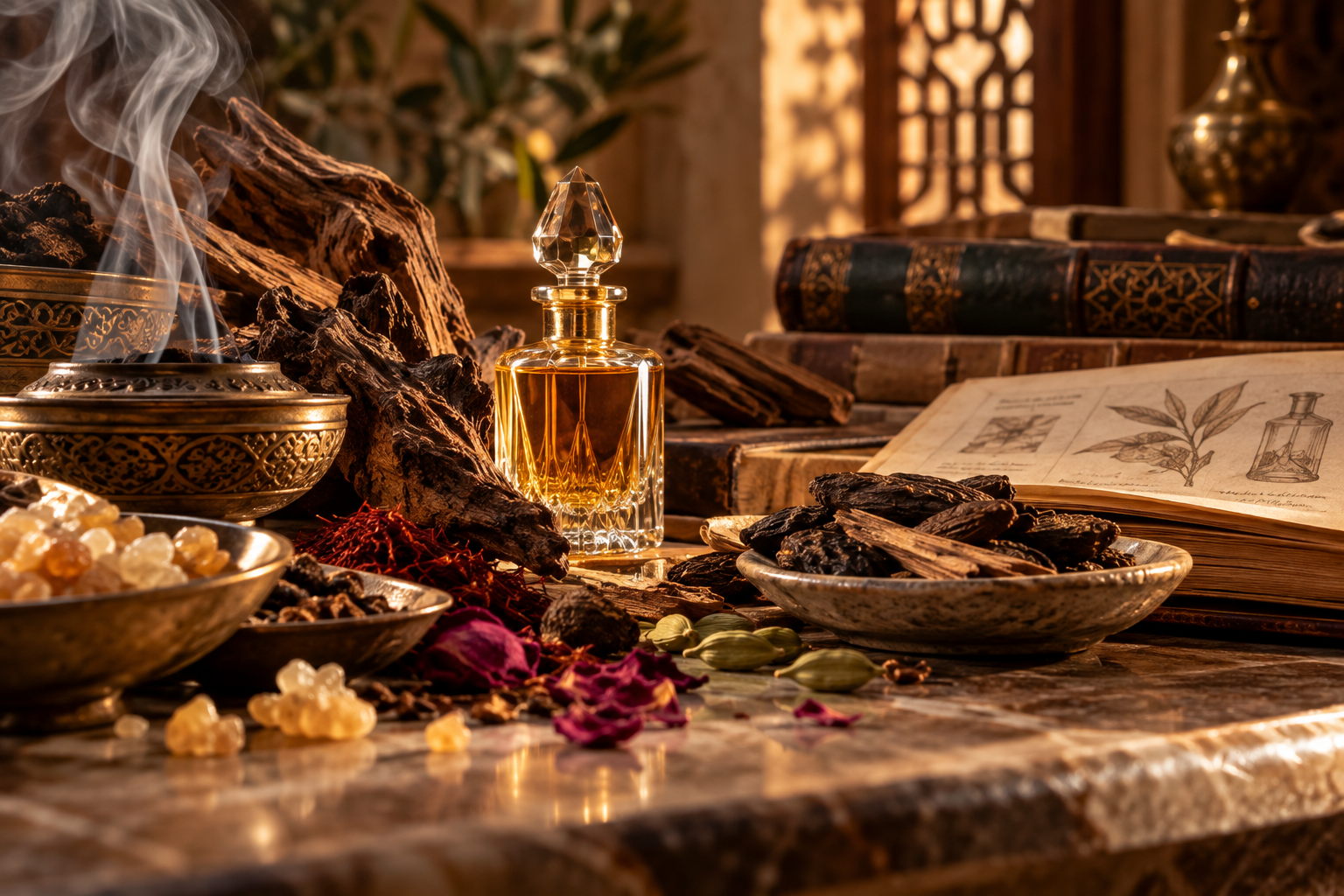
It all started with a book: Medicine of the Prophet by Ibn Qayyim al-Jawziyya.
What struck me was how closely food, medicine and fragrance sat together in its pages. Those categories seemed much less separate than I was used to.
The book brings together Prophetic traditions and the medical understanding of its author’s time.1 What sent me down this particular rabbit hole was a saying of the Prophet Muhammad, peace and blessings be upon him:
“Musk is the best of perfume.”2
I wanted to know what that smelled like.
It seemed a straightforward enough ambition. Find some musk, smell it, satisfy my curiosity. Instead, it became a journey through Arabian perfume oils, niche perfumery, oud, historical recipes and, eventually, making things myself.
Looking back, I can roughly divide it into five acts. Together, they form a journey left unfinished.
Act I — Looking for musk
The obvious place to start was with Middle Eastern fragrance houses: Arabian Oud, Abdul Samad Al Qurashi and others.
There was certainly no shortage of things called musk. Black musk, white musk, Egyptian musk. At this point, I did not really know what I was looking for, or even what musk actually was.
Then came the discovery that the historical material comes from an animal: the male musk deer, native to parts of Asia.3 That put the animal imagery and references to “gazelle musk” into perspective, although musk deer are not gazelles.
This raised the question: what had I been buying?
I began to understand that “musk” could describe a fragrance style as well as an ingredient, and that modern perfumery makes extensive use of synthetic musks. I had been reading the name as an ingredient statement, when it might simply describe the intended scent. I still did not know what was in the bottles I had bought.
I still enjoyed many of those oils. Some of the musks and ambers I discovered then remain scents I appreciate. They simply did not settle the question that had brought me there.
There was also something addictive about the process itself: waiting for a package, opening a small bottle, smelling something unfamiliar for the first time. Sometimes it was a disappointment. Sometimes it was a surprise. Either way, I was learning.
By then, I knew a little more about musk and ambergris. Knowing whether either was actually present in a particular bottle was another matter.
Act II — A case of Amouage attars
Eventually, this led me to the Amouage shop in London.
A member of staff brought out a case of attars, concentrated perfume oils, which were not available to buy there. Those beautiful square bottles introduced me to Tribute, Homage and a world I had barely known existed.
For context, my perfume experience had started with Lynx as a teenager, perhaps some Hugo Boss, and later Lancôme Hypnôse, which became a favourite and still is. This was quite a departure.
Among the bottles was an oud oil. It was the first time I had smelled oud in that form. I had no useful reference for it. I will come back to that bottle, because it deserves its own act.
Amouage also provided a natural bridge into niche spray perfumes. At the time, Jubilation XXV seemed to me about as good as perfume could get. From there came Creed, Xerjoff and more houses than I had originally intended to explore.
There followed a great deal of sampling. I took notes, forgot things, lost some notes and slowly learned to put words to what I was smelling.
That is part of the reason The Aroma Book exists. I wanted somewhere to keep those impressions, including the brief ones, and somewhere to record the next discovery before I forgot it too.
The more specialised my interests became, the smaller that world seemed. Through oud and attars, I met artisans, distillers, perfume makers and fellow enthusiasts who introduced me to materials and fragrances I would probably never have found on my own. Those conversations became as valuable as the samples.
Act III — The oud on my sleeve
I could not get that Amouage oud out of my head.
It was repulsive and deeply attractive at the same time. Durian is probably the closest comparison I can offer: a smell that makes you pull away, then lean back in because you have not quite understood it.
Some of the oil on my wrist rubbed onto the sleeve of my sweatshirt. For days afterwards, I kept returning to that sleeve, trying to work out what I was smelling.
There is something slightly sad about the fact that you cannot repeat a first encounter like that. Once a smell becomes familiar, you can discover more within it, but you cannot quite recover the bewilderment of having no idea what it is.
With time, I found that some of my initial resistance gave way to subtleties I had missed. Coffee offers a useful parallel: the first impression can dominate until you learn to notice what sits behind it.
I also learned not to mistake one oud for all oud. The wood and the way an oil is produced make a difference; soaking and fermentation before distillation can change its aromatic character.4 The challenging side of that first experience was not a requirement that every good oud had to fulfil.
Oud deserves a separate article. In my own search for a perfume holy grail, a beautiful oud oil remains one of the strongest contenders. I often wear it on its own; it deserves to be enjoyed as a perfume in its own right, as well as in a blend.
Act IV — Musk, ambergris and Ghaliya
Eventually, the search returned to where it had begun: musk. By then, ambergris and Ghaliya had become part of it too.
These subjects took me through late nights of research, old Arabic texts, online libraries and a growing stack of books. I wanted to understand the materials, but also what earlier perfume makers had done with them.
Ghaliya particularly captured my imagination. Its name carries the sense of something costly or precious. Historical recipes vary, but musk and ambergris are central to many of them, often worked into an oil with other aromatics.5
My interest was also deeply personal. I wanted to come as close as I could to smelling the perfumes the Prophet, peace and blessings be upon him, might have worn. Reading about its use by his companion Abdullah ibn al-Zubayr drew me further into that search,6 even though I could not confidently establish that the Prophet (PBUH) had used it himself. That connection became part of what inspired me to try recreating it.
Around 2014, I encountered the first artisan Ghaliya I had seen offered for sale online. From my conversations within the niche fragrance community, I understood it to be a first for others too. It was exciting to see something I had been researching become a perfume I could actually buy.
Prior to that release, I had been privately discussing my own efforts to recreate Ghaliya with an artisan. Part of me hoped those conversations might have provided a little inspiration. Either way, I was pleased to see an interest that had felt rather solitary become something shared, as I discovered more artisans offering their own interpretations.
There is a more difficult side to this chapter. Authenticity was only one concern. Animal cruelty is a particular concern with musk; ambergris collected after washing ashore presents a different ethical picture.37
Those questions mattered to me as I tried to establish what I was buying and where it came from. They deserve proper treatment in separate articles.
Perhaps some of what I learned can shorten that journey for others: fewer blind purchases, fewer unnecessary risks, and a little less time spent separating reliable information from confident sales talk.
Act V — Experiments and Creations
Once I began exploring raw materials, it was probably inevitable that I would want to combine them.
Smelling a jasmine extract, for example, could be surprisingly different from smelling a finished perfume described as jasmine. Concentration mattered. So did familiarity. I had to get used to encountering materials before they had been shaped into a finished composition.
I became fascinated by how much could happen within a single material. A rose oil could seem bright and citrus-like at first, then more fully floral, with other facets emerging as it developed. Some materials felt almost like perfumes in their own right.
That deepened my appreciation of naturals without making “natural” a reliable shortcut for “better”. I still liked plenty of the perfumes that had brought me this far. What changed was my interest in what went into them.
Eventually, research turned into experiments: tinctures, macerations, blends, attars, perfumes and my own attempts at Ghaliya.
My early experiments were mostly disappointments. I did not really know what I was doing. I might combine a delicate material with something much rougher, only to find that the delicate character disappeared beneath it. Enjoying the materials individually was one thing; knowing how to make them work together was another.
This is another part of the journey I hope to share here: original formulas, materials I have explored, suppliers I have tried, books worth reading and resources that helped me. Some of the most useful information is simply knowing where to begin.
And then there was incense
Five acts would have been a convenient place to stop. My curiosity did not cooperate.
There was Japanese incense, and incense more generally: agarwood, sandalwood, frankincense and other aromatic materials experienced in another way.
For me, the same attention also extends to coffee, tea, honey and food. Once I started looking more closely at scent, I found more places to enjoy it.
In time, I would like to make room for some of those interests here too.
Why The Aroma Book exists
The Aroma Book is a place to record what I discover and share what might be useful to someone else.
I am an amateur. Most of my reviews are deliberately concise: what I smelled, what stood out and whether I liked it. Sometimes a few sentences say everything I have to say.
The ratings are personal too. One star does not mean that a fragrance is badly made. I can admire the workmanship in something I do not particularly want to smell again. A favourite, meanwhile, need not be rare, expensive or especially complicated.
Think of this as a personal notebook made public. If I dislike something you love, I hope you will read it in that spirit. It is a record of my encounter with it, not a verdict on your taste or the person who made it.
Over the years, I have probably spent something approaching a mortgage deposit on this curiosity. My bank account is certainly lighter. I hope I have come away a little wiser, with experiences and knowledge that can be useful beyond my own collection.
There is a more personal motivation as well. The Prophet, peace and blessings be upon him, taught that beneficial knowledge is among the things through which a person can continue to receive reward after death.8
I hope something I share here will be of benefit. Perhaps it will help someone discover a scent they love, understand a material, avoid a misleading purchase or decide that a particular rabbit hole is best left unexplored.
If a little of that usefulness outlasts me, all the better.
A note on supporting the site
The Aroma Book began as a personal interest and a wish to share what I was learning. That remains its purpose. I would like it to help cover the cost of exploring, making and sharing, without income becoming what determines its direction.
Some links are advertising links through which I earn commission on qualifying purchases. In time, I may also offer original formulas for sale or a Patreon. The core notes and reference material will remain freely available.
If that support helps the project continue, I will be grateful. If it does not, I still intend to keep sharing my impressions.
Sources and reading
- Ibn Qayyim al-Jawziyya, Medicine of the Prophet, translated by Penelope Johnstone, Islamic Texts Society, 1998. See the translator’s introduction for the historical medical context, including the humoral tradition. The discussion here concerns that historical perspective, rather than advice to follow its remedies. Publisher’s page.
- Sahih Muslim 2252b. The short quotation renders the Arabic phrase al-misku atyabu al-tib; English translations vary.
- TRAFFIC, On the Scent: Conserving Musk Deer — the Uses of Musk and Europe’s Role in its Trade. Background on the animal source and conservation concerns; not a guide to current import rules.
- “Augmentation in fragrant agarwood oil quality by fermentation with a microbial consortium of bacterium (Microbacterium oxydans) and fungus (Penicillium aethiopicum)”, 2024.
- “Medieval islamicate aromatherapy: medical perspectives on aromatics and perfumes”. Historical discussion of Ghaliya formulas and the medical context of aromatics.
- Al-‘Ayni, Nukhab al-Afkar, commentary on the report of Abdullah ibn al-Zubayr using fine Ghaliya when entering ihram; al-‘Ayni describes its chain as sound. Arabic text. This report concerns a companion’s practice and does not establish the Prophet’s own use of Ghaliya.
- Natural History Museum, “What is ambergris?”.
- Sahih Muslim 1631.