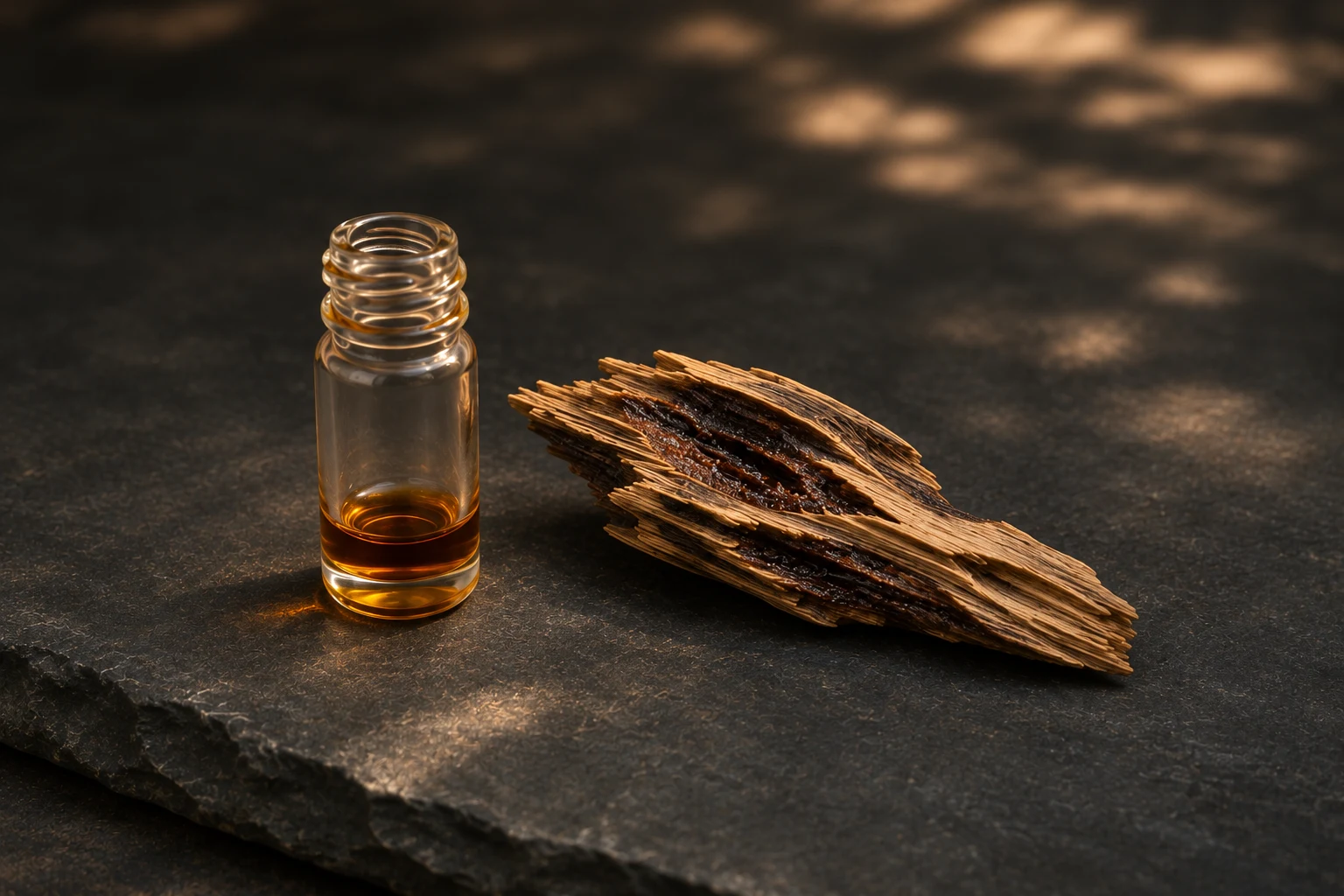
Oud oil turned up during my search for musk. My first encounter with genuine musk was in an artisan’s perfume. The artisan also specialised in oud. That’s where my first bottle came from. Both materials drew much the same small circle of enthusiasts. Agarwood had already caught my attention as one of the perfumes mentioned in the Islamic prophetic tradition.
Before that purchase, I’d smelled genuine oud only three times, including once through Amouage and once through an acquaintance in London. The bottle held an oil distilled from wild Indian agarwood, with a classic Hindi profile.
The scent on the cap alone seemed otherworldly. The barnyard opening was surprisingly clean and soothing, with something of a forest about it. Over time it grew creamy and chocolatey, with hints of incense and leather. It was the most complex aromatic material I’d come across.
People around me who were less familiar with oud picked up a medicinal note. The oil stayed close to the skin and had a quiet, comforting presence that kept drawing me back.
For a first bottle, it was a jump straight to the high end. It felt like driving a luxury car just after getting a licence. The quality was apparent, even if it would take more experience to appreciate everything the oil had to offer.
What is oud?
Agarwood comes mainly from Aquilaria and Gyrinops trees, whose native ranges extend across parts of South and Southeast Asia, southern China and New Guinea. When one of these trees is wounded or infected, it can produce resin as part of its defence. As the resin builds up in the affected wood, it darkens the grain and gives it its fragrance. This resin-rich wood is called agarwood.
Agarwood chips release their scent when heated as incense. Distillation of the wood yields an essential oil. The word “oud” can refer to the wood itself or, in perfumery, to the oil.
Agarwood in the prophetic tradition
The perfuming practice described in Ṣaḥīḥ Muslim uses agarwood as incense. Ibn ʿUmar perfumed himself with the fragrant wood on its own and with camphor. He attributed the practice to the Prophet Muhammad (PBUH). Ṣaḥīḥ Muslim 2254
A separate report in Ṣaḥīḥ al-Bukhārī uses the expression ʿūd al-hindī, literally “Indian wood”. That phrase first led me to think that Indian agarwood had a particular place in the tradition. A parallel version identifies the material as al-kust, or costus. The report describes nasal use for a throat complaint and a separate oral use for what is translated as pleurisy. (This is not medical advice.) Ṣaḥīḥ al-Bukhārī 5713 · 5715
Hindi oud and the barnyard note
At the time, oud oil seemed closely tied to Middle Eastern perfumery. “Hindi” and “Cambodi” were the labels that kept coming up.
The strong, animalic note in those early Hindi oils seemed intrinsic to Indian agarwood itself. Heated as incense, Indian agarwood had none of that funk. Some Hindi oils smell leathery, with a quieter animalic edge. That pronounced barnyard note can also turn up in oils from outside India.
Some distillers soak the wood chips for weeks before distillation. This can soften the wood and help increase oil yield. Fermentation during the soak can bring out a barnyard note in the finished oil. That note can put people off. In the right oil it can be beautiful, especially in the heat or on a damp, foggy winter day.
What the distiller can do
Around that time, artisans were bringing small-batch oud oils to Western niche perfume enthusiasts and experimenting with how the oils were made. The length of the soak, the choice of distillation apparatus and how it’s used all help shape the oil’s scent profile.
The wood itself varies, too. Even within the same species and variety, soil and other growing conditions can influence the character of the agarwood.
CO₂ extraction can also recover fragrant compounds from agarwood, yielding an extract with a different scent profile from the distilled essential oil. The extracts and resin preparations I’ve smelled tend to stay close to the wood’s base scent. A well-distilled oil can have a distinct opening and continue to change as it settles.
A variety of profiles
Oud oils can have multiple profiles, from earthy and leathery to fruity, floral and chocolatey. Some Hindi oils have a leathery character. Thai and Cambodian oils distilled from Aquilaria crassna can smell fruity and floral. Some Bornean oils are camphoraceous and vanillic. In Sri Lankan oils, a camphoraceous note can sit alongside green and fruity ones.
Beneath those differences there is often a woody character that makes the scent recognisable as oud. Some oils have a musky character of their own. Oud and musk together make a precious pairing that we’ll explore further.
Some materials, such as vetiver and sandalwood, can come close to oud in depth. Patchouli can too, though it rarely appeals to me on its own. But oud is the most complex single material I’ve smelled, particularly in its top notes. The distiller’s skill comes through when the opening and heart are as distinctive as the base. A single drop can wear like a whole perfume.
A search for musk had turned up what may now be my favourite material to wear. Perhaps oud was the holy grail all along.
More oud reviews will follow, along with a separate piece on the artisans and where to start sampling.