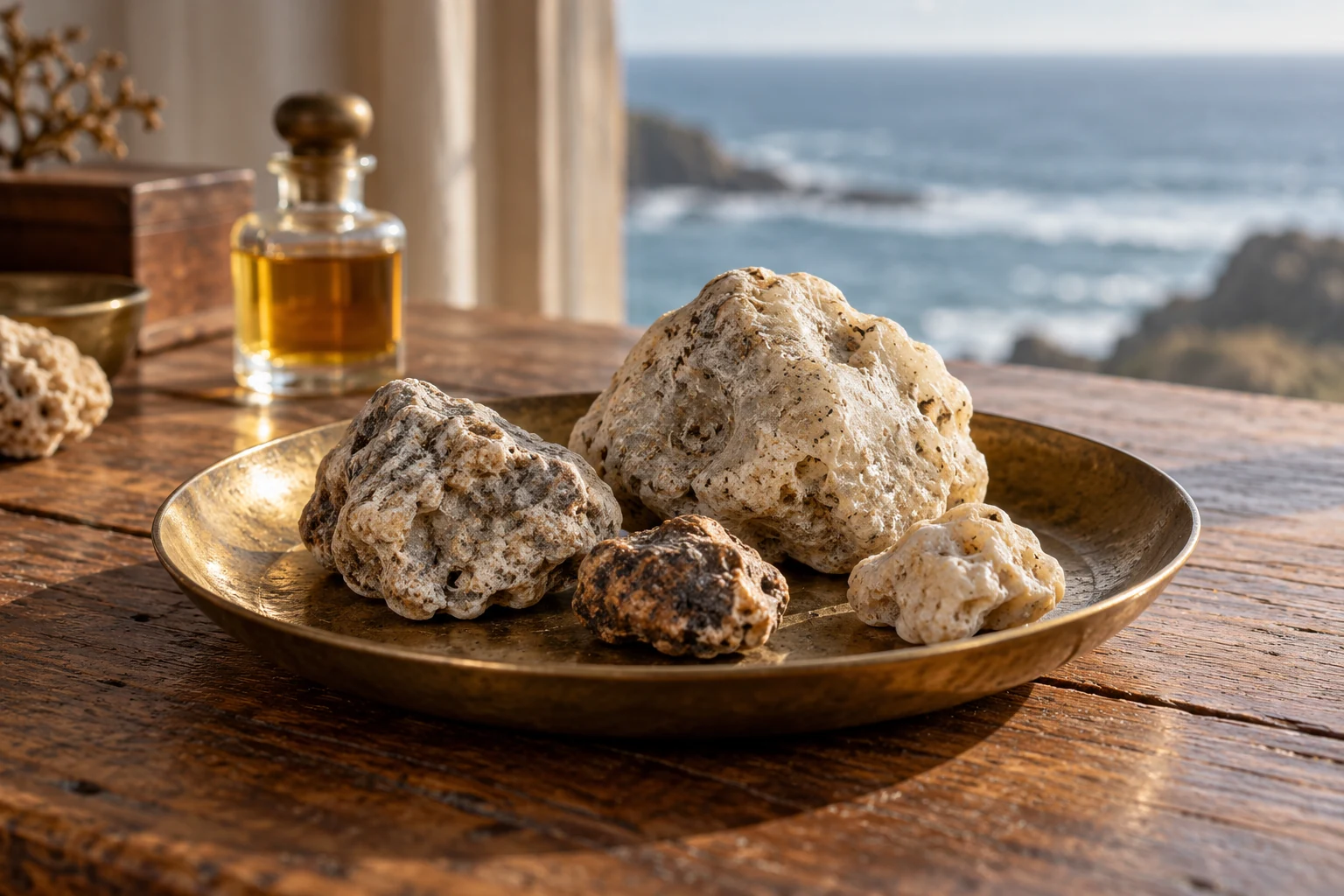
My search for Prophetic perfume began with genuine musk. I struggled to find a source I felt comfortable with, given how musk can be obtained, so I put that search on hold and turned to ambergris. I knew it as ʿanbar (عنبر) and associated it with the Sunnah.1 If musk was the best of perfume, ambergris seemed the second best.
My first encounter with raw ambergris disappointed me. I could barely smell it. An artisan once said to me, “A carrot smells stronger!” I could see the point.
What is ambergris?
Ambergris is a waxy mass that forms in the lower intestine of some sperm whales. Sperm whales regularly bring up the hard squid beaks they can’t digest. Some beaks pass farther down the gut, where ambergris can build up around them.2
The nickname “whale vomit” comes from the idea that the whale brings up the mass. Given where ambergris forms, it seems more likely to me that smaller pieces come out the other end. Exactly how different pieces make it into the sea is still uncertain.3
Ambergris has been recovered from sperm whale carcasses, with fragments of squid beak found embedded in the mass. The idea that the beaks trigger a protective secretion that later forms ambergris remains a hypothesis.4
Fresh ambergris is often black and can smell strongly faecal. It needs to cure before it develops the scent prized in perfumery. After being released from the whale, a piece can spend years adrift before washing ashore. Over that time, seawater, sunlight and air weather it. As ambrein, one of its main constituents, oxidises, it forms compounds that give aged ambergris much of its scent. The piece can grow paler and lose much of that faecal edge. This is how ambergris cures naturally, and the weathered pieces are usually collected where they wash up on beaches.5
A fresh piece taken from a whale would still need to mature, making hunting a futile shortcut to cured ambergris. Some countries allow ambergris to be collected, while others prohibit it.6
What it smells like
I’ve smelled raw ambergris from several regions, from the Atlantic to the Pacific, and across grades from the darkest to the lightest. Across the pieces I’ve smelled, the common thread is an oceanic, almost salty character with a warm, powdery softness. Some can have a ‘bad breath’ type of scent, while dark ambergris can smell faecal. Colour gives some indication of how a piece has weathered. I’d still want to smell it before judging it.7
Sometimes it reminds me of clean skin. In a blend, ambergris can be hard to pick out among the other ingredients, even as it changes how the notes sit together.
ʿAnbar in the Sunnah and traditional uses
The fragrance of the Prophet Muhammad (PBUH) is described as surpassing both musk and ambergris.1 The use of musk and ʿanbar as perfume is also attributed to him in a separate report.8
Al-Suyūṭī gives ambergris second place after musk in Four Princes of Perfume, a literary contest among aromatics. The two materials also come together in recipes for Ghaliya, a compound perfume I’ll return to in a separate article.9
Ambergris was burned as incense and used to scent food and perfume tea.10
What ambergris does in a blend
In modern perfumery, amber usually means a warm, resinous accord built around labdanum and vanilla or vanillin. Fossil amber, the hardened tree resin used in jewellery, has also been used in perfumery as an oil made by dry distillation. For me, the shared name fits only in the sense that both ambergris and an amber accord can lend warmth to a perfume and play a fixative role.11
In a blend, ambergris is more of an effect than a scent. It’s like the work of a midfielder whose pass sets up a goal. The scorer is remembered, while the passer can go unnoticed.
Steffen Arctander described four kinds of fixatives. He called one group “exalting” and gave musk and civet as examples. In his separate entry on ambergris, he describes a material that lasts a long time with relatively little projection, and a tincture that can round out a blend. Today, perfumers often use synthetic alternatives to create ambergris effects.12
If I’d stopped at smelling that first piece, I’d probably still wonder what people saw in ambergris. It took learning about ambergris and experimenting with it in blends to realise how much it could change the feel of a whole perfume. I still have no way of knowing whether the pieces I’ve worked with match the quality of the ambergris praised in the old accounts.
Sources and reading
- Report mentioning musk and ambergris
- Research on the origin of ambergris
- Natural History Museum · Museum reference
- Post-mortem findings · Research on the formation of ambergris
- Natural History Museum · Research on ambrein · Study of ambergris found at sea
- Collection guidance · Collection restrictions
- Natural History Museum
- Report on perfume
- Geert Jan van Gelder’s translation, p. 202 · Encyclopaedia Iranica
- Incense · Food · Tea
- Arctander on amber oil · Labdanum as a fixative
- Arctander on fixatives and ambergris · Modern ambergris materials